

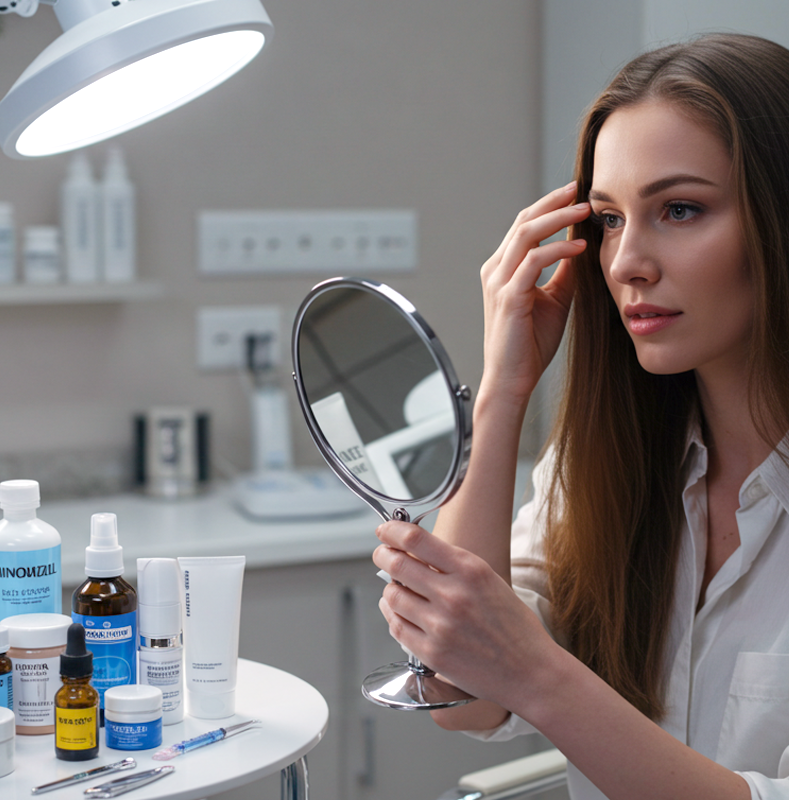
Believing in the importance of spreading health awareness in the community, we at cosmolifekw.com present this series of specialized articles on hair and scalp health.
We have reached the final stop in our journey to understand hair health. After learning about hair biology, types of hair loss, and the importance of scalp health, you may have decided it's time to take a real step towards treatment.
But before you start, it's essential to manage your expectations: treating hair loss takes time, patience, and commitment, and there is no "magic" or instant solution.
Real, tangible results often begin to appear after 3 to 6 months of regular treatment use, and it may take a full year to judge its effectiveness completely.
This article will give you a realistic, evidence-based look at the available treatment options, from products you can buy at the pharmacy to advanced medications and procedures offered by dermatologists.
Over-the-Counter Treatments: The First Line of Treatment
Minoxidil:
Minoxidil is the only topical treatment approved by the U.S. Food and Drug Administration (FDA) to treat androgenetic alopecia (hereditary baldness) in both men and women, and it is the most widely used treatment in the world.
How does it work? The exact mechanism of Minoxidil is not fully understood, but it works in several ways:
- Extending the Anagen (Growth) Phase: It works to prolong the active growth phase of follicles and shorten the Telogen (resting) phase.
- Stimulating Blood Circulation: It increases blood flow around the hair follicles, providing more oxygen and nutrients.
- Stimulating Growth Factors: It stimulates the production of Vascular Endothelial Growth Factor (VEGF), which plays a role in follicle growth.
Available Concentrations and Usage:
- For Women: 2% solution twice daily, or 5% foam once daily.
- For Men: 5% solution or foam twice daily. It should be applied directly to a dry scalp.
Realistic Expectations and Side Effects:
You may notice a temporary increase in hair shedding during the first few weeks of use. This is normal and means the treatment is working to push out old hair to make way for new growth.
Initial results begin to appear after 4 to 6 months of regular daily use and peak after about a year.
The most common side effects are scalp irritation or itching.
In rare cases, it may cause unwanted facial hair growth.
Crucial Point: To maintain results, Minoxidil must be used continuously.
When you stop using it, hair loss will return to its previous state within 3 to 4 months.
Prescription Medications: Specialized Treatment

When over-the-counter treatments are not sufficient, or in specific cases requiring stronger intervention, dermatologists prescribe medications that target the root causes of the problem.
Finasteride: A DHT Blocker for Men Only
Finasteride is an oral medication approved by the FDA for the treatment of male pattern baldness.
It is strictly prohibited for women, especially those who are pregnant or planning to become pregnant, as it can cause serious birth defects in male fetuses.
How does it work? Finasteride works by inhibiting the type II 5-alpha reductase enzyme, which is responsible for converting testosterone to DHT.
This leads to a significant decrease in DHT levels in the scalp (about 90%) and blood (about 70%), which stops the process of follicle miniaturization and allows some to regrow.
Efficacy and Side Effects:
Studies have shown that about 90% of men taking Finasteride experience a halt in hair loss, and more than 60% notice some regrowth.
The usual dose is one tablet (1 mg) daily, and results begin to appear after 3-6 months.
The most concerning side effects, although rare (affecting less than 2-3% of users), are sexual side effects, such as decreased libido or erectile dysfunction.
These risks should be discussed fully with a doctor.
Antifungals for Tinea Capitis
As mentioned earlier, topical treatment alone is ineffective. Treating tinea capitis requires a course of oral antifungal medications for several weeks, prescribed by a doctor after confirming the diagnosis.
These drugs include Griseofulvin, Terbinafine, Itraconazole, or Fluconazole.
Corticosteroids for Alopecia Areata
To control the autoimmune attack, corticosteroids are the primary treatment:
- Local Injections: This is the most effective option for limited patches, where the drug is injected directly into the affected skin every 4-6 weeks to stop inflammation and stimulate growth.
- Topical Creams or Oral Medications: These can be used in certain cases or for children, but are less effective than injections.
Advanced Medical Procedures: When Medications Aren't Enough

In some cases, more advanced procedures may be needed to achieve the desired results.
Platelet-Rich Plasma (PRP) Injections
This procedure uses the patient's own blood to stimulate hair growth.
How is it done? A small amount of the patient's blood is drawn and then placed in a centrifuge to separate the platelet-rich plasma.
This concentrated plasma is then injected into areas of the scalp experiencing thinning.
How does it work? Platelets are rich in natural growth factors that are thought to stimulate stem cells in hair follicles, improve blood circulation, and prolong the growth phase.
Protocol and Results: It typically requires 3 initial sessions one month apart, followed by maintenance sessions every 4-6 months.
Results may begin to appear after 3 months.
Low-Level Laser Therapy (LLLT)
This is an FDA-approved treatment for men and women that uses devices like helmets or combs that emit red light at a specific wavelength.
How does it work? It is believed that red light stimulates the mitochondria (the powerhouses) in follicle cells, increasing energy production and encouraging the extension of the growth phase.
Usage: It requires regular use, typically 3 times a week for 20-30 minutes.
Hair Transplantation: The Final Surgical Solution
When other treatments fail or in cases of advanced baldness, hair transplantation is the most permanent option.
How is it done? DHT-resistant hair follicles are moved from the donor area (usually the back and sides of the head) and implanted in the bald areas (the front and crown).
Main Techniques:
- FUT (Follicular Unit Transplantation): A strip of skin is taken from the donor area and divided into individual follicular units.
- FUE (Follicular Unit Extraction): Follicles are extracted one by one directly from the scalp, leaving tiny dot scars instead of a linear scar.
The Most Important Message: Don't Start Any Treatment Without an Accurate Diagnosis
The world of hair loss treatments is vast and complex, and starting the wrong treatment can be costly and frustrating.
A dermatologist is your primary partner on this journey. They can:
- Provide an Accurate Diagnosis: Precisely determine the type of hair loss you are experiencing.
- Perform Necessary Tests: Rule out underlying causes like vitamin deficiencies or thyroid problems.
- Create a Customized Treatment Plan: The plan may include a combination of treatments for the best results.
- Follow Up and Adjust the Plan: Evaluate your response to the treatment and adjust the plan as needed.
Healthy Hair Starts Here
We have reached the end of our series, having journeyed from the depths of the hair follicle to the latest technologies in dermatology clinics.
We hope this information has provided you with the knowledge and confidence to take positive steps towards healthier hair.
Remember that healthy hair is a continuous journey of care and patience.
Start with the basics: understand your hair type, build a preventive routine, and nourish your body well.
If you face a problem, remember that early and accurate diagnosis is the key to successful treatment.
Your hair is a part of you, and when you take care of it, it will reward you with the strength and beauty you deserve.
Important Note: The information in this article is for educational purposes only and is not a substitute for consulting a doctor or pharmacist.
An accurate diagnosis and appropriate treatment always require specialized medical consultation.
Frequently Asked Questions About Hair Loss Treatment
Q: Are hair loss treatments readily available in Gulf pharmacies and clinics?
A: Yes, most basic treatments like Minoxidil are available in major pharmacies without a prescription. Prescription medications like Finasteride are also available. Advanced procedures such as Platelet-Rich Plasma (PRP) injections and hair transplantation are widely available in specialized dermatology and cosmetic clinics in major cities.
Q: How much do hair loss treatments cost in the region?
A: Costs vary significantly. Topical Minoxidil can cost between 15-30 Kuwaiti Dinars per month. A single PRP injection session ranges from 70-150 Dinars, and you typically need 3-4 initial sessions. Hair transplantation is the most expensive procedure, ranging from 1,500 to 5,000 Dinars or more, depending on the number of grafts and the technique used.
Q: Does the hot climate affect the effectiveness of topical treatments like Minoxidil?
A: Yes, it might. Excessive sweating in a hot climate can reduce the scalp's absorption of the topical treatment or cause it to run off. It is advisable to apply Minoxidil to a completely dry scalp, preferably in the evening or when you are in an air-conditioned environment to ensure it stays on the scalp for as long as possible.
Q: Can treatments be used during fasting in Ramadan?
A: Topical treatments like Minoxidil foam or solution do not break the fast, as their systemic absorption is very minimal. Oral medications like Finasteride can be taken with the Iftar or Suhoor meals. It is always best to consult your doctor to set a suitable treatment schedule during Ramadan.
Q: Are traditional remedies like castor oil or garlic really effective?
A: While some natural oils may improve hair moisture and overall appearance, there is no strong scientific evidence from institutions like the AAD or EADV to support their effectiveness in treating the root causes of hair loss such as androgenetic alopecia or alopecia areata. They can be used as part of a care routine but should not be considered a substitute for approved medical treatments.
The "Hair Health Between Science and Care" series has ended - we hope this information will be useful in your journey towards healthier, more beautiful hair.
For more information and personalized advice, we invite you to visit our website cosmolifekw.com. Never hesitate to contact our customer service, as our team includes beauty experts ready to serve you and answer all your inquiries.
Sources:
- American Academy of Dermatology (AAD)
- European Academy of Dermatology and Venereology (EADV)


